
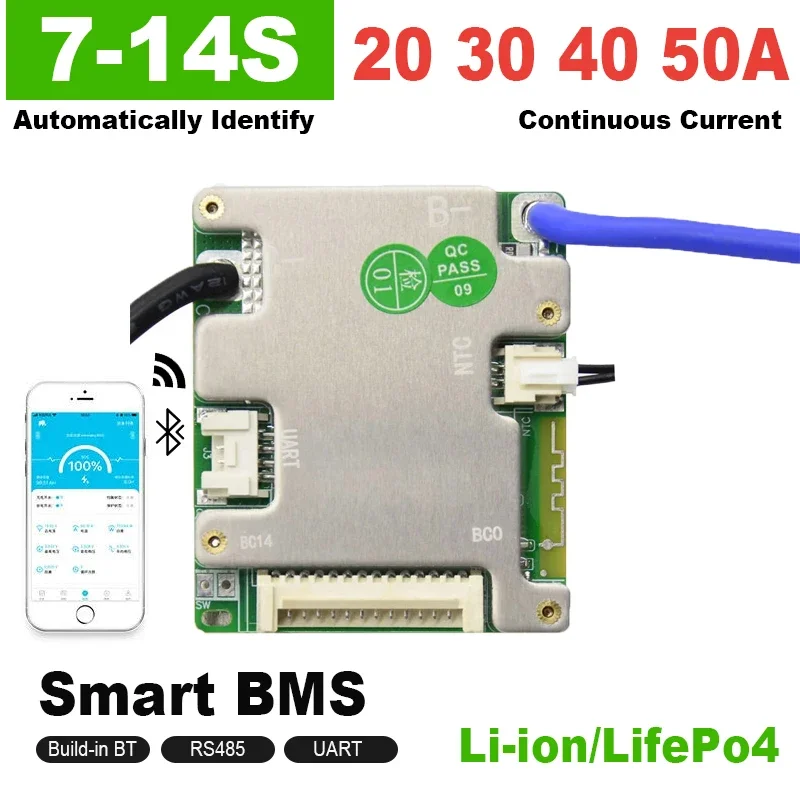
JBD Smart BMS 7-14S Automized Identify 24V 36V 48V 20A 30A 40A 50A Built-in BT UART NTC Li-ion LiFePo4 Balanced Board For E-Bike
Return&refund policy
Eligible items are covered by return and refund support. If the item does not arrive or is not as described, the buyer can request help.
Security & Privacy
Safe payments: We do not share your personal details with any third parties without your consent.
Secure personal details: We protect your privacy and keep your personal details safe and secure.
AI offer for your market
A curated pick based on category, shipping route, delivery speed and popularity in your selected market.
Why this product fits your market
- • Strong customer signal: 4.7★ from 48 reviews.
- • Recommendations focus on this product category and your market availability.



Product specifications
Detailed product description
This product is shown with available options, market-specific pricing and verified specifications.
- Brand: NONE
- Sales: 89
- Package size: 10 × 10 × 10 cm
- Package weight: 0.5 kg
- Rating: 4.7 / 5
Before adding to cart, choose an available option and check the quantity.
IOS version needs to pay to change the parameters (need to be within the specified range)
Android version can change the parameter settings
IOS: Search it in the APP STORE
Please notice the following point when you installing it.
Before installing the protection board, the batteries should be matched well (the voltage difference of each battery should not be higher than 0.05v, the internal resistance difference should not be greater than 5m 0, and the capacity difference should be less than 30mah). lf the power on voltage is too high, the protection board may be protected and the protection board can not work normally. lf the battery is full, please lower it to the required voltage and then connect the BMS. Batteries should be connected in paralleland then connected in series.
Wiring sequence: first connect the b-wire to the total negative electrode of the battery(b negative wire should be welded with short thick wire), and then connect the flat wire! before welding the flat cable, it is necessary to pull the cable from the board.
Flat cable: start from BCO, BCO is connected to the total negative pole of the battery, the flat cable BCI next to BCO is connected with the positive pole of the string of batteries, that is, the positive pole of battery No 1,the positive pole of battery No. 1, the positive pole of battery No. 2,the positive pole of battery No. 3,and so on.
After connecting the cable, measure the voltage between each two adjacent wires from the head of the cable. The voltage of polymer battery should be less than 4V, and that of iron lithium battery should be less than 3.5V. After checking, insert the flat cable, andthen connect the negative pole of charger and load to C -. B negative wire and C negative wire need to be welded with thick wire. The connection method of parallel wire has nothing to do with color, only the sequence is correct.
Then measure whether the total voltage of the battery is equal to the out put voltage of the protection board, and the equal protection board will work normally.
Please note: the BMS has been used and welded wire will not be returned or replaced The protection board is guaranteed for one year. Due to low profit, within the warranty period, maintenance is free, the return freight by yourself.B- thick wire needs to be welded first then continue to connect other wires, B- wire welding too thin too long or do not welding will burn the plate!B- Weld studs!
Protection function description
Overcharge protection:When the battery is under the charging state, the voltage keeps going up. When the protection board detects that the voltage of any cell is higher than the overcharge protection value, the protection board will start timing immediately. When the time reaches the overcharge protection delay, the protection board will turn off the charging MOS tube, at that time, it cannot be charged.
Overcharge protection recovery: After the overvoltage protection appears on the protection board, the battery voltage will going down under the static or discharge state of the battery. When the protection board detects that each voltage is lower than the recovery voltage of the overcharge protection, the protection board will output a signal and turn on the charging MOS tube to charge.
Over-discharge protection: When the battery is under the discharge state, the voltage keeps going down. When the protection board detects that the voltage of any cell is lower than the overcharge protection value, the protection board will start timing immediately. When the time reaches the over discharge protection delay, the output signal of the protection board will turn off the discharge MOS tube, the load lock circuit will work, but, it cannot discharge at this time.
Over discharge protection recovery: After the over discharge protection appears on the protection board, the battery voltage will going up under the static or discharge state of the battery. When the protection board detects that each voltage is higher than the recovery voltage of the over discharge protection. At this time, disconnect the load or charge, the protection board will output a signal and turn on the charging MOS tube to charge.
Overcurrent protection: When the battery is under the static or discharge state, the current suddenly increases. When the protection board detects that the current reaches the overcurrent protection value, the protection board will start timing at that time. When the current duration in the circuit reaches the overcurrent protection delay time, the output signal of the protection board will turn off the discharge MOS tube, and the load lock circuit will work. At this time, the discharge cannot be conducted.
Overcurrent protection recovery: After the discharge overcurrent protection appears on the protection board, the discharge MOS tube is turned off, and the current in the loop becomes 0. At this time, the load is disconnected or charged, the output signal of the protection board will turn on the discharge MOS tube to discharge.