
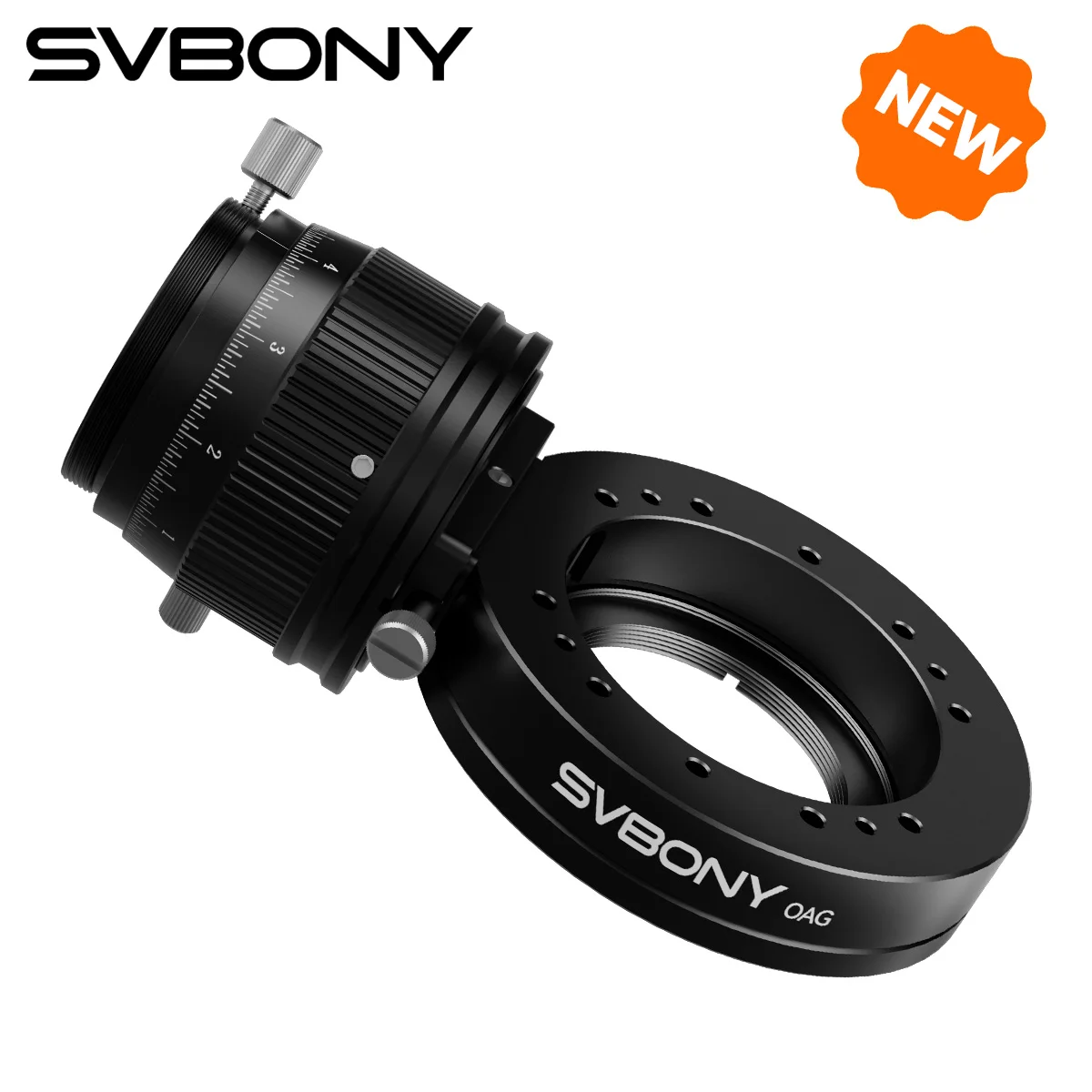
Svbony SV238 Astronomy OAG Off Axis Guider for Deep Sky Astrophotography for SV503 SV550 MK127 Astronomical Telescope Black
Return&refund policy
Eligible items are covered by return and refund support. If the item does not arrive or is not as described, the buyer can request help.
Security & Privacy
Safe payments: We do not share your personal details with any third parties without your consent.
Secure personal details: We protect your privacy and keep your personal details safe and secure.
AI offer for your market
A curated pick based on category, shipping route, delivery speed and popularity in your selected market.
Why this product fits your market
- • Strong customer signal: 4.9★ from 33 reviews.
- • Recommendations focus on this product category and your market availability.


Product specifications
Detailed product description
This product is shown with available options, market-specific pricing and verified specifications.
- Brand: svbony
- Sales: 96
- Package size: 17 × 13 × 10 cm
- Package weight: 0.5 kg
- Rating: 4.9 / 5
Before adding to cart, choose an available option and check the quantity.
SV238 OAG Off-Axis Guider Cannot be used in conjunction with SV226 M42 filter drawer
Can only be used in conjunction with SV226 M54 and SV226P filter drawer
Note: SV238 only works with the plug-in type guiding cameras (CMOS sensor is close to the prism), it is not applicable to guiding cameras that have the CMOS sensor positioned at the bottom of the camera body.
SV238 Astronomy Off-Axis Guider (OAG)
Precise Guidance, Capture Every Star
8×14mm Large-surface Prism
Dual Helical Focuser
A dual helical focuser on the OAG allows ultra-fine, backlash-free focusing of the guide camera, ensuring pinpoint guide stars and accurate long-exposure tracking.
Adjustable Prism Height
Adjustable prism height — fine-tune the prism position to capture bright guide stars without vignetting your main imaging camera.
Compact and Powerful OAG
This OAG features a large 8x14mm prism, capturing a wider guide field for easier deep-sky imaging. It's designed with multiple interfaces and adapters for compatibility with most cameras and telescopes. Compact yet powerful, it helps you capture stunning celestial shots.
Wide Thread Support
M54, M48 & M42 adapters let you connect effortlessly to the majority of and telescopes without extra adapters.
CNC-Machined Unibody
It withstands outdoor temperature shifts without deformation, delivering stable performance for astrophotography in all conditions.
SV238 Off-Axis Guider + SV226P Filter Drawer Combo
Package Includes
Off-axis guider*1
M54 threaded ring*1
M48 adapter ring*1
M54-M42 adapter ring*1
M48-M42 adapter ring*1
M2.5*8 hex socket screw*12
M3*12 hex socket screw*16
M2 long round 7-shaped wrench*1
M2.5 long round 7-shaped wrench*1
User manual*1
SVBONY SV226P Filter Drawer 1.25" &2" Filter Mounted Integrated Molding Anti-Light-Leaking Design for OAG
SVBONY filter drawer featuring the anti-light-leaking design that can effectively solve the light leaking issue under long exposure. The product is designed as a perfect circle, with a simple and beautiful appearance and good surface. Two pairs of strong magnets are used to achieve strong adsorption. 2-in-1 design, can use offilter1.25" & 2" specifications on the market. Meanwhile, by optimizing the threaded opening, it has been improved to have better OAG compatibility.
Features
1.2-in-1 design, can use offilter1.25" & 2" specifications on the market
2.With strong the ability of double strong magnetic adsorption, it is more convenient and much easier to install or pull out the filter.
3.Twelve M2.5 female threads are evenly distributed at the telescope end, supporting OAG fastening connections
4.Advanced CNC integrated molding processing, quality assurance
5.Lock screw on the side of it. The locking function is helpful on adjusting the tension to eliminate the gap, which is a double insurance for users.
6.The filter drawer comes with the M42-M48 adapter To resolve the thread compatibility issue.
Specification
1.Brand: SVBONY
2.Model: SV226P
3.Product Name: Filter Drawer
4.Thickness: 21mm
5.Support Filter size: 1.25" &2"
6.Material:Aluminum
7.Camera side thread: M42 x0.75 (male)
8.Filter mounts thread: M48x0.75/M28.5x0.6 (female)
9.Telescope side thread: M48x0.75 (female)
Drawer Frame x 1PCS
2" Filter Slider x2PCS
2"-1.25" Filter Adapter x1PCS
M42F-M48M Adapter x 1PCS
Plastic Case x 1PCS
Q&A
Q1: The main camera is in focus, but the guiding camera is always out of focus. What should I do?
A: The key is to align the imaging planes of the two cameras.
Procedure
1. First, focus only on the main camera to achieve precise focus.
2. Loosen the guiding camera's locking ring and use the sliding/rack mount to slowly extend or retract it until the star points become smaller and more solid.
3. If necessary, slightly adjust the height of the prism (by inserting or retracting a small amount).
4. Finally, "lightly lock—fine-tune—finally lock" to avoid rebound. It is recommended to mark the extension of the guiding camera for easy resetting next time.
Q2: Can't find a guide star/the star is too faint, especially during narrowband imaging. What should I do?
A: First, confirm that the OAG is placed before the filter wheel/filter (so that guiding does not pass through the narrowband filter).
Then
1. Rotate the OAG (changing quadrants often helps to find a brighter star).
2. Slightly raise the prism (until a dark corner appears, then retreat).
3. Set the guiding camera exposure to 1–3 s, moderately increase the gain, or use 2×2 binning.
4. In urban light pollution, choose a brighter target area.
5. Check if the lens cap/cover is not removed and if the focal plane is close enough.
Q3: Shadows/uneven dark corners appear in the main image. Is it because the prism is blocking the light?
A: Very likely.
Solution
1. Retract the prism by 0.5–1 mm.
2. Slightly rotate the OAG to change the light intake position.
3. Full-frame cameras are more sensitive; if dark corners still exist, consider an OAG with a larger aperture/prism or upgrade the camera port to an M54/M68 diameter.
4. Also, check if the back focus is correct (incorrect back focus can also exacerbate edge issues).
Q4: Is there a recommended "first-time setup" checklist?
1. Confirm the interface and thread pitch (M42/M48/M54) and target back focus.
2. Assemble in the order of "telescope → field flattener/focal reducer → OAG → filter wheel → main camera."
3. Focus the main camera.
4. Adjust the height of the guiding camera and prism to achieve simultaneous focus.